
I hope you like Hi-Tech reviews, because this one is. After more than 10 years of dealing with all sorts of studio gear, Hi-Tech stuff is still my favorite topic of exploration. My first acquaintance with Monster Cable Studio Pro took place at the sound madness of the NAMM show where I played. I was struck and could not believe my ears. Technological solutions involved in the design of this cable got me even more interested so I decided to run a simple test in the studio.
Let me ask a question first. How many cables do you have in your signal chain in the studio? It’s great when you keep the chain as simple as a guitar-amp and mic – preamp -DAW. Even in this case the cables are a part of the tone. However there is a common approach to use a splitter and record DI signal in addition to the amp. What does it mean besides flexibility? Noise! Or, worse signal to noise ratio, to be exact. Let’s leave the discussion of whether passive or active splitters are better – there are pros and cons of both. Many purists prefer passive splitters which means lower level signal traveling twice the length of cables. Unbalanced instrument cables dealing with low level signals are the weakest part of the chain being prone to interference from surrounding electronic devices, networks, wireless spots etc. and as a result can be accumulating a sensible level of noise.
What can you do with that?
- Use the shortest cables possible.
- Use balanced connections where possible – professional and a lot of semi-pro gear is equipped with balanced connectors.
- Use the best cables and connectors you can afford. Expensive instruments and pieces of gear make no sense if the cables suck. Equally, replacing just one cable with a good one, while there are 9 more noisy makes no sense either.
A simple rule to remember:
The quality of the signal chain ( = the sound you get) is defined by it’s weakest link.
In addition to the noise rejection characteristics the cables do influence the tone a lot, providing different frequency response, clarity, and even latency depending on the material and technological solutions involved.
This is what most instrument cables look like – basic unbalanced construction:

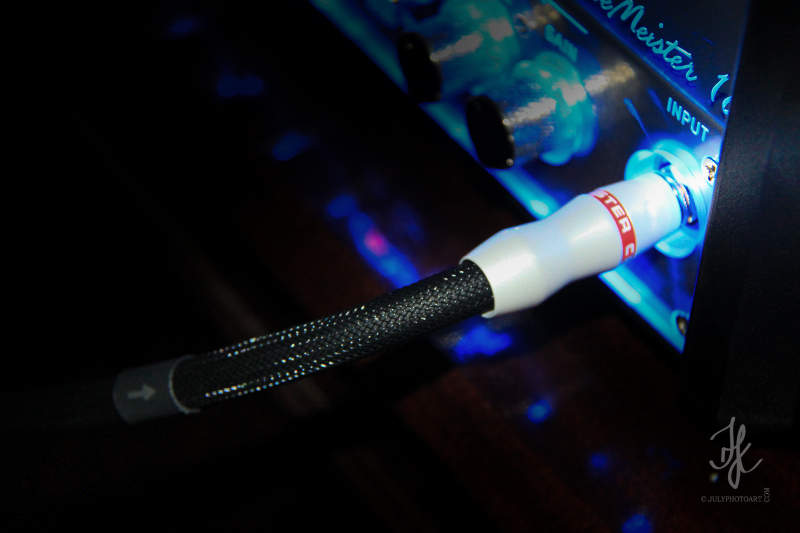
Can a cable be a hi-tech masterpiece? Yes, it can! Monster Cable Studio Pro SP-1000 pictured below. The difference is obvious, isn’t it?

Check this out:
- Multiple gauge high- and low-frequency wire networks for accurate, natural sound reproduction
- Double shielded with 97% coverage copper braid and carbon-infused dielectric for superior noise rejection.
- MultiTwist™ impedance-balanced construction for maximum signal transfer and noise rejection.
- MicroFiber® dielectric-wrapped wire networks for the fastest transients, maximum clarity, definition and presence.
- 24k gold-plated contact, heavy-duty, high-current connectors are durable and corrosion resistant.
Monster Cable Studio Pro‘s great accuracy and transparency are achieved by utilizing patented Time Correct® windings, multiple gauge wire networks and Bandwidth Balanced® construction.
One more thing: note a little arrow next to one of the connectors and don’t mess it up by plugging wrong! With Studio Pro it does matter which direction the sound travels.
The Test
For the test I have replaced all the cables in the signal chain (except pedal board using short custom patches) with Monster SP-1000 Studio Pro Instrument and Mic cables. Monster Cable SP1000 happened to be longer than the ones I used for comparison. Pictured below is a sample setup.

Noise levels recorded from hi-gain preamp out*:
1) regular cables

2) Monster Cable Studio Pro showing -15dB noise reduction compared to regular cables. Overall sound appeared to be more open and detailed.
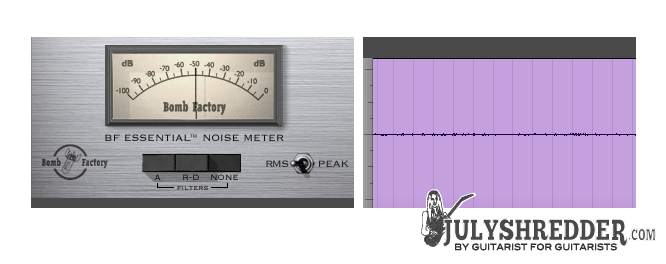
*Test results may differ depending on a chosen studio environment, setup and gear used. The goal of this test was to demonstrate obvious difference in performance which every user can experience, rather than provide any sort of absolute numbers.
Let’s Rock!
Monster Cable Rock, Jazz, Bass and Acoustic Cables are designed to provide the best performance and frequency response for the chosen instruments/styles – names speak for themselves. These cables are lighter, more flexible and slightly more affordable than Studio Pro which makes them perfect for live situations.

Monster Rock Features:
- 95% coverage copper braided shield rejects RFI and EMI for a lower noise floor and increased resolution
- IsoTec vibration isolation technology further reduces handling noise
- Extra-flexible Duraflex outer jacket for superior reliability and cut resistance
- 24k 1/4″ gold-plated contact connectors with collar strain relief are durable and corrosion resistant
- Multiple Time Correct windings phase align signal for natural reproduction of midrange frequencies
- MicroFiber inner dielectric provides better isolation of magnetic fields for improved harmonic detail
Monster Rock Guitar cable sound fully justified its name – powerful, bright and vivid with great detail and impressively good isolation from hum and interference.
Oh, and all the Monster Cables tested look and feel absolutely gorgeous and durable: both Studio Pro with its heavy-duty black nylon mesh jacket and smooth Monster Rock, all connectors feel massive and durable and are easy to grab. All Monster cables go with a very cool and handy bonus: bright branded strap stickers keeping the cables coiled in a correct way without damaging.
Resume:
Test results may differ depending on a chosen studio environment, setup and gear used. The goal of this test was to demonstrate obvious difference in performance which every user can experience, rather than provide any sort of absolute numbers. And the result is impressive. It’s not about subtle frequency response nuances which can be discussed and compared for hours, it is straight in the face declaration of robust performance in a far from ideal environment. They sound as they look. Monster!
Special thanks to INSIDE LTD and Monster Cable for cable samples.


Photography © 2012 Julia Kosterova – www.julyphotoart.com / www.julyshredder.com